what is the best way to catch cash in a air tunnel
Pneumatic tube ship
by Chris Woodford. Last updated: April 16, 2021.
If yous enjoying reading the Sherlock Holmes detective stories, you'll know in that location'south every chance yous'll run across a deadly assassinator looming on the next page, set up to strike at a moment's notice with his toxicant-tipped blowpipe. These age-old weapons are classic examples of pneumatic engineering science: they use the power of compressed air—blowing hard on 1 end of a pipe fires a missile at loftier speed from the other end. In the late-19th century, around the same fourth dimension the Sherlock Holmes tales were kickoff published, blowpipe technology became very popular for sending messages and pocket-sized objects down much longer pipes linking remote parts of large buildings. In our modern age of fiber-optics and the Net, yous might call up this rather quaint "pneumatic transportation" is a matter of the past—but yous'd exist wrong. Thousands of hospitals, factories, banks, department stores, and other places even so rely on pneumatic tube transport to motion medicines, cash packets, and other small-scale items with speed, security, and efficiency. I drive-through McDonald's even uses a system like this to evangelize burgers to its customers! So how exactly practise pneumatic tubes work? Let's take a closer look!
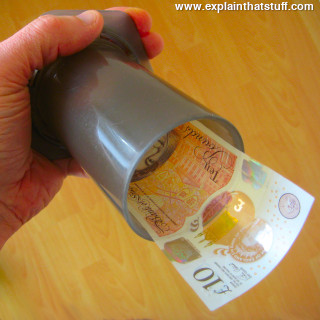
Photo: Demand to send cash speedily and securely to another function of your building? You could use a pneumatic send canister like this. Information technology'southward made from a tough plastic called polycarbonate, which protects whatever y'all pack inside. Once the tube is loaded, you screw a cap on the end and identify it in the transport tube to be sucked or diddled to its destination roughly 5–6 times faster than a messenger could carry it.
Contents
- What is pneumatic tube ship?
- How does pneumatic tube transport piece of work?
- Advantages and disadvantages
- Typical uses
- Find out more
What is pneumatic tube transport?

Photograph: Pneumatic tubes accept been used at the United states Library of Congress since the late 19th century to send requests between readers and the stores where archive materials are held. The system might seem archaic, but it's tried, tested, and efficient—and still used in parts of the Library to this day. Note the ii metallic doors opening up for incoming tubes (left) and outgoing tubes (right, and currently beingness loaded by the operator). You tin also see 2 spare tubes continuing at the lesser. Read more about the system in A Serial of Tubes from the Library blog, December 16, 2011. Photo courtesy of U.s.a. Library of Congress.
Pneumatic tube systems (also called PTT, airlift, air transport, Lamson tubes, air tubes, and pneumatic transit systems) are amazingly simple—and best illustrated by case...
Suppose you run a large department store full of checkouts (cash desks) that are taking money from customers all day long. To reduce the risk of theft, it's a skilful idea to collect that coin every and then oftentimes and remove it to a identify that'south more secure earlier you deposit it in the bank. You lot could have a cashier walk around all the checkouts in turn, just that takes time and it makes the cashier vulnerable to robbery. As well, some checkouts will take money more than often than others, then information technology's generally improve if the checkout operator dispatches money at regular intervals every bit it suits them.
A mutual solution many stores employ is to take a pneumatic tube system linking each checkout with the cashier's department, a strong room often located on a different flooring of the building. Every time the checkout operator collects more than a sure amount of greenbacks, they dispatch information technology securely to the cashier'south department using the pneumatic tube.
How does pneumatic tube send work?

Photo: Lamson tubes similar this were used in the CIA's behemothic, 50km (30 mile) pneumatic tube network between 1962 and 1989. Photo courtesy of CIA published on Flickr.
For simplicity, let's assume we're linking 1 checkout with the cashier's department. The checkout has a large metal box called the sending station with a door that opens onto a tube. Some systems have doors that lock with keys or open up with numeric keypads and Pivot numbers; others are unsecured. The tube (a pipage made of something similar PVC plastic or a strong lightweight metallic such as aluminum) runs all the mode to the cashier's section, often only a short altitude but sometimes up to 600m (~2000ft) or so. At the cashier'due south department, the tube connects to a more sophisticated box called the receiving station, which may also have a lockable door. This is sometimes also called the powered station, because it provides the air power that moves packages back and forth. Information technology's essentially the aforementioned every bit the sending station, but it has a compressed air pump attached that tin either suck air from the tube or blow air into it according to which mode downward the tube packages need to be sent. Ofttimes, the sending and receiving stations have chimes, ringers, or flashing lights to bespeak when a parcel has just been received.
Most of the time the receiving station will be collecting cash packages from the checkouts so information technology will exist set to receiving mode (also chosen vacuum mode). This means the compressor will be working like a vacuum cleaner and so information technology sucks air along the tube from the sending station. If someone wants to transport cash from the sending station, they simply load it into a sturdy cylindrical, plastic canister (only slightly smaller than the tube and very snugly fitting), identify it in the tube in the sending station, and shut the door. When properly loaded, it blocks and seals the tube. Now every bit the compressor sucks on the tube, information technology creates a partial vacuum in front end of the canister that sucks information technology all the fashion along until it reaches the receiving station, where it can be unloaded. Canisters can be sent in the opposite direction merely by setting the compressor to accident air along the tube in the contrary direction (behind a canister, pushing it along); department stores oft send pocket-size alter back to checkouts that mode.

Artwork: How a pneumatic send arrangement works: a tube links the sending and receiving stations. The air compressor pump at the receiving station can suck or blow air. When it sucks, it pulls canisters along the tube toward information technology; when it blows, information technology pushes the canisters in the reverse direction.
Just equally a vacuum cleaner is limited by the suction ability of its electric motor, so pneumatic ship tubes are limited in what they can behave, how quickly, and how far. Typically, canisters are virtually v–15cm (ii–6 inches) in diameter and 20–30cm (~8–12 inches) long, made of a toughened plastic such as polycarbonate, and take rubbery bumpers at the ends to provide a good air seal and prevent noise as they travel downwardly the tubes. They unscrew at one end to comport pocket-size items weighing up to nigh 2kg (~5lbs) or and then at speeds of up to 10m (33ft) per 2d. That equates to about 36km/h or 22mph—or roughly 5–six times faster than a person can walk.
Most pneumatic tube systems are very simple networks linking 1 receiving station with a number of sending stations, or vice-versa. Withal, much more than elaborate, computer-controlled systems are also commonplace, in which many sending stations link to many receiving stations and packages can route and transfer in all manner of complex ways; these are the sorts of systems that hospitals use. A big pneumatic system might have up to 500 sending and receiving stations, dozens of transfer units where packages can be routed between senders and receivers in circuitous means, and dozens of compressor/blower units to provide the pneumatic power.
Advantages and disadvantages
Pneumatic tube systems are a fast, simple, secure, and reliable way of transporting small objects relatively large distances across a edifice or (using surreptitious or overground pipes) between buildings on the same site. They can motility things upwardly, downwardly, or sideways and, because they're pneumatic, provide a soft, air-cushioned ride for frail items (many systems use air-cushioned brakes or bumpers that bring arriving canisters slowly to a rest at the receiving station). Since they remove the demand for a person to conduct things, systems like this relieve fourth dimension and money and tend to pay for themselves quite speedily. They likewise offer secure connections between different parts of a building, reducing opportunities for theft and accidental damage in transit.
If they accept a disadvantage, information technology's that the tubes that link stations ideally need to be planned into a building's infrastructure when information technology'south offset designed (perfectly possible for something like a new hospital or department store); it's harder (though far from impossible) to install a complex organisation with many sending and receiving terminals into an existing, older edifice.
Typical uses

Photo: Tubes, ancient and modern! This 1942 photo shows the big-scale transport tube arrangement used to connect the master yard part of the Illinois Central Railroad with other offices nearby. Photo by Jack Delano, U.S. Farm Security Administration/Part of War Information, courtesy of Library of Congress, Prints & Photographs Segmentation, FSA/OWI Collection, [LC-USW3-010495-D].
Systems like this are widely used in hospitals and department stores, so those are the places to keep your eyes peeled if yous're hoping to spot pneumatic tubes in action. You're virtually likely to detect them near checkout desks, especially when someone sends a bundle of money off to the cashier's department. Look out for a box (with or without a key lock or numeric keypad) with a tube coming out of the summit and disappearing into the ceiling up above. You're unlikely to employ a system like this direct unless yous piece of work in a bank, store, or hospital, although some pharmacies and banks do use pneumatic tubes to deliver items securely to self-service, electronic kiosks.
Call up of tube transport and y'all mostly recall of cylinders shooting down round pipes, only it'due south possible to send other-shaped containers (such as flat, flexible certificate wallets) downwardly flattened pneumatic "tubes" as well. Lamson patented a system like this for sending flexible envelopes back in 1930 and numerous other, like systems have been developed since then for transporting things like checks and banknotes. Typically, the containers (made from fiber-lath or plastic) can exist securely sealed, simply have extra hinged flaps on their outsides (a scrap like pockets or wings) that catch in the air stream, allowing them to be blown finer through the tube. 1 of the big advantages of systems similar this is that beefy send tube containers aren't needed, and (in places like shops where the transport of items is mostly in 1 management), you don't accept to keep returning a limited supply of empty containers to the stations where they came from. They can by and large also be used in more confined spaces. The main drawback is the chance of valuable items getting stuck or damaged.
Looking to the hereafter, Tesla electric car pioneer Elon Musk has proposed using a scaled-upwardly version of tube engineering science to transport people between cities at speeds of nigh 1100 km/h (700 mph). Known as Hyperloop, the idea has certainly captured people'southward imagination, and regularly features in the tech press. Whether it will e'er come to fruition remains to be seen; some contempo predictions suggest it might not exist around till 2040, at the earliest. If it sounds crazy, it's worth remembering that numerous 19th-century engineers (including English language engineer Isambard Kingdom Brunel) tried to build atmospheric railways, in which the passenger cars are pushed or pulled past differences in air pressure. None succeeded—steam engines proved cheaper, more than flexible, and more reliable—but the idea was reborn in the late 20th century, and a handful of successful, minor-calibration atmospheric railroads do now operate around the earth.
And if you remember Elon Musk is a genius for coming up with the idea, don't forget that we've been here before. Two centuries ago, mode back in 1829, artist William Heath drew this very similar thought as part of an elaborate joke called "The March of Intellect." Information technology'southward a vacuum transport tube speeding people on petty carriages from London, England to Bengal, India!

Artwork: William Heath'south early version of Hyperloop. Artwork courtesy of Wikimedia Commons published under a Creative Commons (CC By 4.0) licence.
Find out more
On this website
- Compressors and pumps
- Electric motors
- Hydraulics
- Jackhammers/pneumatic drills
- Pneumatics
On other websites
Articles
Full general and historical
- Series of tubes: Pneumatic Networks Then & Now: Steve Levenstein presents a diverse drove of pneumatic tube systems from the past and present in this article from Web Urbanist (a fascinating illustrated urban art, design, and civilization blog).
- Gone with the current of air: Tubes are whisking samples beyond infirmary: Sara Wykes explains how a large and very elaborate pneumatic tube system makes life easier at Stanford Hospital.
- The CIA Museum Artifacts: Pneumatic-Tube Carrier: The CIA Museum explains how pneumatic tubes were the Internet of their day!
- Who was Lamson of the tubes? by Ann Ingwersen, Museum of Australian Democracy. Nosotros talk virtually "Lamson" tubes, but we should actually recall their original inventor, William Murdoch, argues the writer of this article.
- Pneumatic air bulldoze-through McDonald's: BenFrantzDale has put a short video of the infamous pneumatic McDonald's on his Flickr page. Watch the burger guy load a meal into a pneumatic tube and shoot it off to his waiting customer!
- Beach Pneumatic Transit: A fascinating account of the early, prototype pneumatic railroad that was tunneled under New York Metropolis in the 1870s.
- Within Roosevelt Island's Futuristic Pneumatic Tube Trash Organisation past Michelle Young. Untapped New York, April 9, 2020. Pneumatic systems don't merely movement valuable things—they tin can also shift trash.
Topical news
- A Step Forward in the Promise of Ultrafast 'Hyperloops' by Eric A. Taub, The New York Times, November eight, 2020. A sneak preview of Virgin's Hyperloop prototype.
- Researchers Say Hyperloop Tech Won't Be Fix Until 2040 by Ed Blazina, Pittsburgh Psot Gazatte, Apr 21, 2020. The concept may be expert, but the technology could accept decades and billions to test, regulate, and put into practice.
- Dutch Hyperloop programme optics Amsterdam to Paris in xc minutes past Francesca Street, CNN, April 17, 2020. Interest in hyperloops is starting to spread effectually the globe.
- Tin can a 700 M.P.H. Train in a Tube Be for Real? by Allison Arieff. The New York Times, May 19, 2016. An enthusiastic look at the current state of the Hyperloop project.
- Elon Musk unveils San Francisco-LA 'Hyperloop' idea by Jonathan Amos. BBC News, 12 August 2013. Elon Musk'due south ambitious plan to piping people from Los Angeles to San Francisco is an "enlarged version of the quondam pneumatic tubes used to send mail service and packages with and between buildings". Read more on Musk's Hyperloop blog, which includes a 58-page downloadable outline of his thought.
- Whoosh! The Trash Can as a Pneumatic Tube by Emily S. Rueb. The New York Times. April 9, 2010. Pneumatic technology powers Manhattan's Automated Vacuum Assisted Collections facility, a kind of "pneumatic trash sewer" that could make traditional garbage collection obsolete.
- Tube freight transportation by Lawrence Vance and Milton 1000. Mills, Public Roads, Federal Highway Administration, Fall 1994. This fascinating commodity considers whether behemothic versions of pneumatic transport tubes could exist used to ship freight over long distances.
Photos
- Pneumatic tubes: Pictures of tube systems, former and new, that people take shared on Flickr.
Patents
There are lots of technical patents covering all kinds of variants on pneumatic tube transport; here'south just a modest option.
- US7424340B2: System and method for pneumatic send by Timothy J. Owens, CDA Group, September 9, 2008. A modernistic, calculator-controlled organization for servicing many sending and receiving stations.
- EP0664264A1: Package for transporting valuables in a pneumatic conveyer arrangement past Daniel Rat, Brinks SA, September 10, 1997. A plastic wallet for sending cash and other items.
- EP0034940B1: Pneumatic tube carrier arrangement by Donald Alexander at al, Lamson, March fourteen, 1984. An improved pneumatic organisation for use in more confined spaces.
- US3295662A: Fundamental exchange dispatcher for pneumatic tube systems by Peter F Crosby et al, Lamson, January three, 1967. A detailed description of a big, complex Lamson-type installation.
- US1951820A: Pneumatic acceleration tube by Merton Fifty. Emerson, Lamson, March 20, 1934. A Lamson system for transporting flat certificate wallets.
Source: https://www.explainthatstuff.com/pneumatic-tube-transport.html
0 Response to "what is the best way to catch cash in a air tunnel"
Post a Comment